
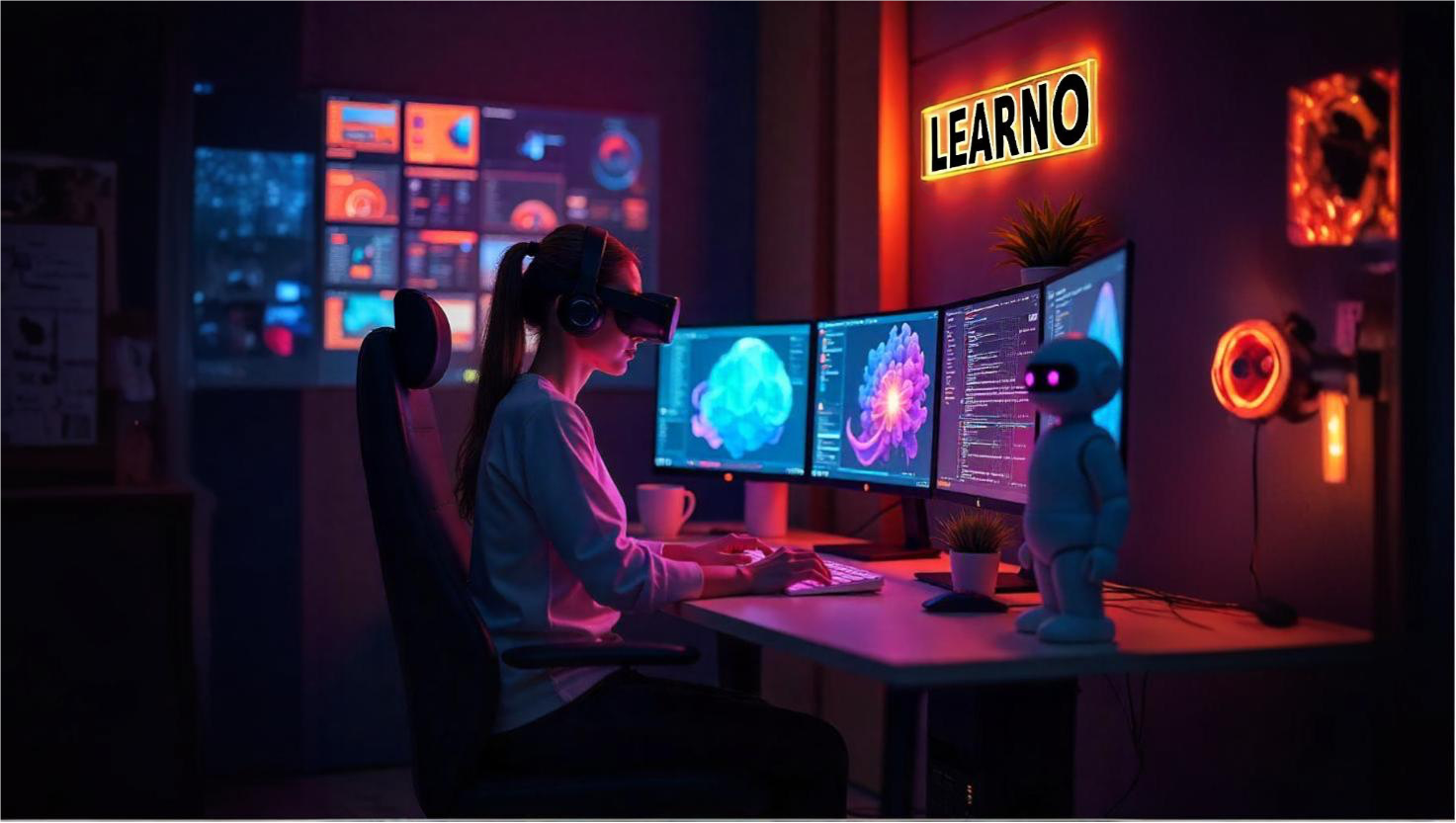
Why AI, micro-moments, and virtual adventures are reshaping how we learn
“The illiterate of the 21st century will not be those who cannot read and write, but those who cannot learn, unlearn, and relearn.” – Alvin Toffler
2025 is not just another year in digital learning — it’s a tipping point. The ground beneath traditional training models is shifting fast. Learners want speed, relevance, and flexibility. Employers need results. And technology is offering superpowers we couldn’t have imagined just a few years ago.
So, what should you watch? Here are five seismic trends that are redefining the future of learning. Not as theory—but as practical waves you can ride to innovate faster, teach better, and grow smarter.
1. 🚀 AI Isn’t Coming—It’s Already Running the Class
AI is no longer the future—it’s the co-pilot of modern learning.
Imagine a learning companion who watches how you learn, anticipates your confusion before you even feel it, and quietly reroutes the path to make learning frictionless. That’s what AI is doing in 2025. It’s the invisible tutor, the quiet creator, and the relentless organiser.
✅ Personalised Learning Paths Forget cookie-cutter courses. AI now builds learning journeys based on who you are—your pace, your knowledge gaps, your preferences. Think Spotify playlists, but for your mind.
✅ Fast Content Creation Need a quiz? A quick micro-course? A simulation? AI can whip it up in minutes. Tools like Articulate and Synthesia are empowering L&D teams to do in a day what used to take weeks.
✅ Your 24/7 AI Tutor Remember Clippy from Microsoft Word? Now imagine Clippy with a PhD and empathy. Intelligent tutoring systems answer questions, give feedback, and guide you in real time—like having a calm coach in your pocket.
✅ Predictive Learning Analytics Before you fail a quiz, the system already knows. AI is scanning your patterns, flagging challenges, and suggesting interventions—making learning as adaptive as Netflix’s recommendations.
🎯 Bottom line: AI is your backstage crew, script writer, and stage manager. It’s making learning more tailored, timely, and scalable than ever before.
2. ⏱️ Microlearning: Because Time Is the New Currency
“If you can’t explain it simply, you don’t understand it well enough.” – Albert Einstein
We’re in the age of learning on the go. People want knowledge the way they consume TikToks: short, sharp, and immediately useful.
✅ Snackable Content 5-minute videos. 3-question quizzes. A quick simulation on handling a difficult customer. Microlearning gives people exactly what they need—just in time, just enough.
✅ Anywhere, Anytime Access Whether it’s on a coffee break, during a commute, or between meetings, learning fits into the cracks of daily life. Mobile-first design isn’t a bonus—it’s the baseline.
✅ Micro, But Mighty Don’t be fooled by the brevity. These bite-sized lessons punch above their weight when it comes to retention. Learners can revisit, replay, and apply them easily.
🧠 Nano Nudges Some companies are even sending “learning nudges”—a tiny scenario, reflection question, or alert that reinforces yesterday’s lesson today. It’s not annoying—it’s brain-smart repetition.
🎯 Bottom line: Think of microlearning as the espresso shot of education. Small, potent, and energising exactly when you need it.
3. 🥽 Immersive Learning: Training Through Alternate Realities
Once the stuff of sci-fi, Virtual Reality (VR), Augmented Reality (AR), and Extended Reality (XR) are becoming tools of the trade—especially where doing beats watching.
Picture this: You’re a trainee nurse. Instead of watching a video on CPR, you’re inside a virtual ER, your hands reaching to perform compressions, your decisions saving a simulated life. That’s immersive learning.
✅ Simulated Experience From fire drills to factory lines, learners can practise, fail, and try again—without real-world consequences. Safety meets mastery.
✅ Multi-Sensory Engagement We remember more when multiple senses are engaged. With VR and haptics (think gloves that vibrate), learning feels real. It’s active, embodied, and unforgettable.
✅ Gearless XR Don’t have a headset? No worries. XR is now being delivered via regular browsers and smartphones. Accessibility is catching up to ambition.
✅ Remote Collaboration in Virtual Worlds Teams from five continents can now “meet” on an oil rig, inside a 3D prototype, or around a virtual whiteboard. Think Zoom, but with depth, movement, and presence.
🎯 Bottom line: Immersive learning is not just cool tech—it’s purposeful play. It brings theory to life and builds confidence like nothing else can.
4. 🤝 Social Learning: We Learn Best Together
“Alone we can do so little; together we can do so much.” – Helen Keller
We’re hardwired to learn socially. From childhood mimicry to peer feedback in the workplace, learning has always been a team sport. Now, eLearning is catching up.
✅ Communities of Practice Discussion boards, peer groups, and collaborative projects are turning static courses into dynamic ecosystems. It’s not just what you learn—it’s who you learn it with.
✅ Real-Time Interaction Live polls, breakout rooms, and Q&As are adding layers of interactivity to digital courses. Learning feels less like a lecture and more like a conversation.
✅ Crowdsourced Brilliance Learners are co-creating content. Got a new tip? Share it. Solved a tricky customer scenario? Upload your solution. This isn’t top-down training—it’s a roundtable.
✅ Gamified Collaboration Challenges, competitions, and team quests are driving engagement. When learners feel they’re contributing—not just consuming—they’re far more invested.
🎯 Bottom line: Social learning injects humanity back into digital education. It turns knowledge-sharing into culture-building.
5. 📊 Data-Driven Learning: What Gets Measured, Gets Mastered
“In God we trust; all others must bring data.” – W. Edwards Deming
In 2025, data isn’t just something you collect. It’s what powers everything—decisions, designs, diagnostics, and results.
✅ Insight into Learner Behaviour Which modules are skipped? Where do learners stall? When do they drop off? Analytics gives you the X-ray vision to see what’s working and what’s not.
✅ Smarter Design Decisions Rather than guessing, you now know which videos are too long, which assessments are too easy, and which paths need a redesign. It’s like having heat maps for brains.
✅ Performance ROI Gone are the days when L&D was a cost centre. With analytics, you can now link learning outcomes to performance outcomes. Training that moves the needle is no longer a mystery.
✅ Continuous Improvement Loop Data isn’t just a report—it’s feedback. And feedback fuels refinement. Every learning product can get better every week, not every year.
🎯 Bottom line: In a world awash with data, the winners will be those who know how to use it wisely—and in real time.
🌊 Final Word: Learn Like a Surfer
If you think about it, learning in 2025 is a bit like surfing. You need to watch the waves (trends), choose the right board (tools), and practise the art of balance (personalisation + performance).
You can’t control the ocean—but you can learn how to ride it.
The five trends above aren’t optional add-ons—they’re essential levers for anyone designing, delivering, or funding learning in the next 12 months.
And the best part? The future isn’t just coming. It’s learnable.
Chris Gaborit is a serial entrepreneur and founder of Learno, an AI-powered eLearning company delivering digital training to Fortune 500 companies worldwide. For most of his life, Chris has travelled the globe inspiring ordinary people to achieve extraordinary things—through stories, learning, and meaningful connection. He’s written for The Sydney Morning Herald, LinkedIn, and Fast Company.
📍 Follow the wave:
🔗 LinkedIn: https://lnkd.in/grBRPbWQ
📸 Instagram: https://lnkd.in/gqJRWpbM
✖ X (formerly Twitter): https://x.com/chrisgaborit
🌐 Website: https://www.learno.com.au
#Learno #LearnoWave #learno-eLearning #chrisgaborit