5 Years After COVID: Lessons, Research & Real Stories from the Front Lines of Remote Work
Pre-COVID, managing remote teams was a niche skill — often reserved for tech startups or global projects. Most managers never had to think about time zones, asynchronous workflows, or digital culture. Then COVID hit. Overnight, we all became remote managers.
We improvised. We over-Zoomed. We checked green dots like lifelines. We survived.
But now, five years on, survival is no longer the goal. It’s time for mastery. So what have we really learned? What does the latest research say? And how are the best remote leaders building teams that thrive — not despite the distance, but because of how they lead through it?
“We Thought Slack Was Enough”
In Bandera, Texas, Rafael — a remote manager at a global infrastructure company was leading over 40 engineers across five time zones. At first, he tried to replicate office life virtually: daily check-ins, Slack always open, decisions made in live calls.
But soon, things cracked.
“One day a critical incident was mis-handled because two engineers assumed the other had escalated,” Rafael wrote. “We realized half our decisions weren’t being recorded anywhere.”
That wake-up call led him to restructure everything: fewer meetings, asynchronous workflows, decision logs, and defined norms around response times. Within weeks, productivity rose — and so did morale.
“People said they no longer felt they had to be seen to be working,” he shared.
Source: The Remote Manager’s Toolkit – Fusion94
1. 🎯 Stop Watching the Clock — Start Measuring What Matters
It’s easy to mistake online presence for actual performance. Green dots, quick replies, back-to-back meetings — they give an illusion of momentum. But activity isn’t the same as achievement.
A four-year study from Great Place to Work found remote/hybrid productivity remains strong — but top performers don’t rely on visibility. They thrive on shared goals, team cooperation, and clarity around outcomes.
Companies like GitLab and Automattic lead the way: deliverables are tracked in transparent systems, not behind status updates. Managers aren’t monitoring—they’re mentoring.
TAKEAWAY: Shift your focus from hours logged to impact delivered. Build systems that track what matters. Performance is the outcome, not the attendance.
2. 🧭 The GPS Every Team Needs: Clarity as the New Currency
Few things create more stress than not knowing who’s responsible for what — or when it’s due. In a remote world, ambiguity doesn’t just slow work down. It exhausts people.
Harvard research reveals that the companies thriving in hybrid models are those with codified practices, clear playbooks, and agreed ways of working. In remote contexts, documentation isn’t bureaucracy — it’s a gift.
One success story? A startup I heard about replaced recurring status meetings with a shared “Decision Log” and weekly async updates. The result? Fewer meetings, more momentum.
TAKEAWAY: Create a living playbook. Document everything: who owns what, how tools are used, when people are available. Don’t assume alignment — design for it.
3. 🌡️ Burnout in Disguise: Why Engagement Isn’t Enough
Your team might be hitting deadlines and showing up to meetings — but underneath, is there simmering fatigue?
The Remote Productivity Study warned that high-performing remote teams can still suffer in silence. Engagement scores stay high while well-being plummets.
Remote-first organisations like Blackbaud combat this by weaving well-being into operations: mandatory offline hours, no-meeting Fridays, well-being check-ins.
TAKEAWAY: Build well-being into workflows. Respect personal time. Make recovery as normal as performance. Burnout isn’t a weakness — it’s a warning.
4. 📢 The Danger of the Invisible High Performer
Have you ever notice not everyone shines on Zoom? Some people lead with quiet consistency rather than loud charisma — and in remote environments, that can be easy to miss.
Not every contribution shows up in a dashboard. And without intentional visibility systems, remote workers — especially from underrepresented groups — fall through the cracks.
A 2024 case study found hybrid models boosted inclusion only when leaders actively curated recognition, access, and equity. The risk? Remote becomes synonymous with forgotten.
Automattic addresses this head-on. They’ve designed their culture to ensure quiet contributors don’t disappear. How? Through structured rituals: team-wide recognition channels, mentorship tracks that match junior staff with senior advocates, and promotion pathways that rely on written contributions, not just face time in meetings. Everyone knows how visibility works — because it’s not accidental. It’s intentional.
Visibility isn’t random — it’s engineered.
TAKEAWAY: Take a fresh look at how recognition works in your team. Are you rewarding only the most vocal or visible people? Or the ones consistently creating value behind the scenes? Create space for every type of contribution to be seen — by rotating visibility, documenting wins, and building equity into feedback and promotion cycles.
5. 🔧 Too Many Tools, Too Little Flow
For many remote workers, a typical day might involve juggling five platforms before lunch. Communication is scattered. Focus is fractured. And somewhere along the way, real work gets delayed.
Tool fatigue is real.
Studies show that overload erodes focus and motivation. The best teams use fewer tools, better — with clear rules of engagement.
One company implemented a “tool charter”: what each tool is for, when to use it, how to shut it off. Meetings dropped. Output rose.
TAKEAWAY: Trim your tech stack. Clarify use. Focus on flow, not features. The best collaboration happens when tools disappear.
Final Word: The Offer Letter Reveal
In one remote meeting with 30 people on the call, a colleague believed they’d paused screen sharing — but hadn’t. Instead of the presentation slides, everyone saw their inbox… and an open offer letter from another company.
They didn’t even notice. Until someone in the chat wrote quietly: “Hey, you’re still sharing.” Cue awkward silence. And a very fast Alt+Tab.
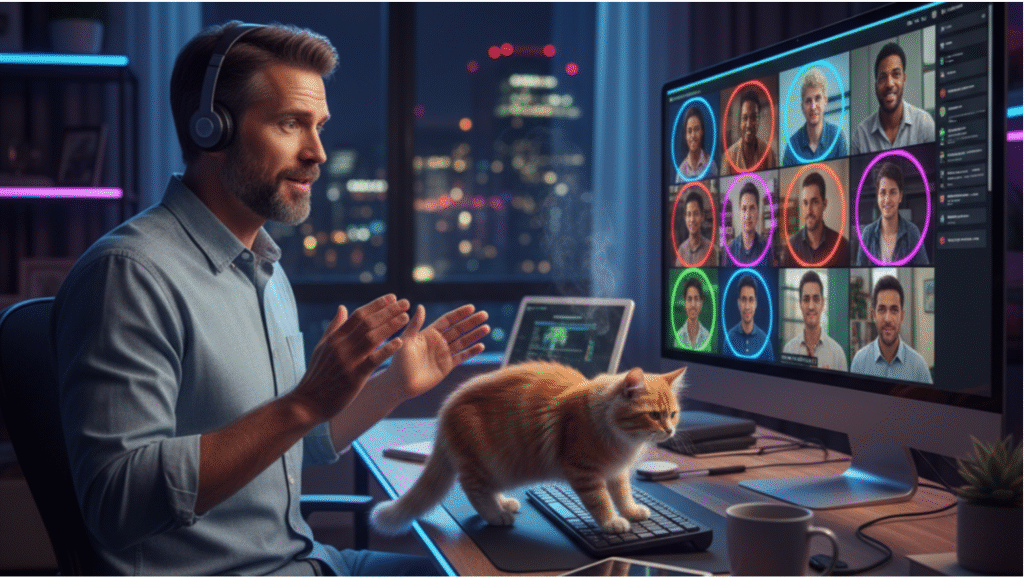
Remote work is serious — performance, clarity, trust. But it’s also human. Mistakes will happen. Cats will walk on keyboards. Offers will accidentally go public. And leaders? We keep showing up — one calm recovery at a time.
Because it’s not just about running teams. It’s about leading people who work differently, think independently, and still want to belong.
So here’s your challenge: What’s one small reset your team needs this week? Go first. Lead light. And maybe, just maybe — double-check your screen share.
THE AUTHOR
Chris Gaborit is a lifelong learner and passionate entrepreneur who founded Learno, an AI-powered eLearning company dedicated to transforming the way organisations grow and develop their people.
For over 25 years, Chris has worked with Fortune 100, ASX 500, and leading SMEs to design learning that doesn’t just inform—it inspires change, drives performance, and makes a lasting difference in the workplace.
Blending practical experience with creativity, Chris combines cutting-edge AI, immersive design, cinematic videography, and drone footage to deliver learning experiences that truly engage. His work is driven by a single mission: to help companies build cultures where people thrive, learn, and succeed together.
A strong advocate for reimagining learning in the age of AI, Chris has written for The Sydney Morning Herald, Fast Company, and LinkedIn, sharing insights on how organisations can unlock the full potential of their teams.
💬 Got a learning project in mind? Chris would love to hear from you.
📍 Follow the wave:
🔗 LinkedIn: https://www.linkedin.com/in/gaborit/
📸 Instagram: https://www.instagram.com/chrisgaborit/
✖ X (formerly Twitter): https://x.com/chrisgaborit
🌐 Website: https://www.learno.com.au
#RemoteLeadership #HybridTeams #FutureOfWork #LeadershipDevelopment #TeamCulture #WorkFromAnywhere #PeopleFirst #RemoteWorkTips #ChrisGaborit #Learno