
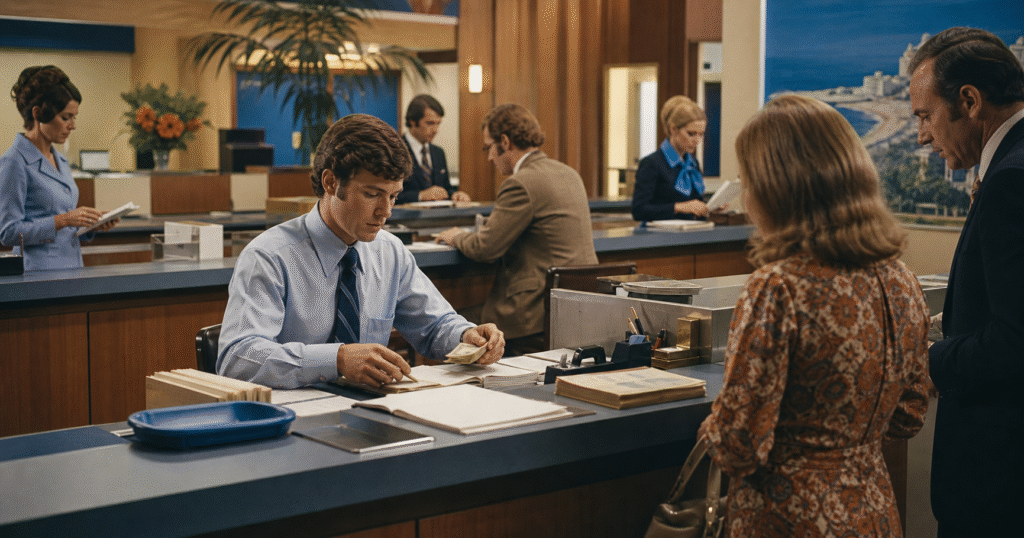
In the mid 1970s, I walked into the Commonwealth Bank at Sandgate as a “Junior” and I was sent up to Brisbane for two weeks of teller training. I had no idea that those ten days would end up shaping the next decades of my working life.
Back then, training wasn’t a slideshow and a quiz. It was an apprenticeship in miniature. The bank built a fake branch inside the training room in Brisbane — with teller boxes, a counter, a till, real money 💵 — and the trainers took turns playing customers. Friendly ones. Confused ones. Angry ones. We had to learn to read them all, calm them down, and get the transaction right, every single time.
And “getting it right” mattered, because at the end of every day we balanced our cash. To the cent. If you were out, you found out why before you went home. There was no hiding from a mistake — it showed up in the drawer, in front of everyone, and you learned very quickly to slow down and pay attention.
💡 IT WAS ALL DONE BY HAND
It’s hard to explain to anyone who started their career after computers took over just how manual it all was. Every customer had a savings passbook. They’d fill out a deposit or withdrawal slip, hand over their book, and we’d write the transaction on the next line — adding to the balance if they were depositing, subtracting if they were withdrawing — then stamp it. Those slips would then be sent back to the customer’s home branch, where staff kept square bins full of ledger sheets, one for every single account, and manually adjusted the balance by hand. No terminals. No real-time anything. Just arithmetic, attention, and trust — and a whole system that ran on people getting the small things right, consistently, all day long.
We were drilled on all of it: the mechanics of cash handling, the discipline of balancing, and — just as importantly — how to hold your composure when a difficult customer was standing right in front of you, unhappy, and it was your job to sort it out calmly. It was intensive, it was nerve-wracking, and it was also, looking back, one of the best-designed learning experiences I’ve ever been part of. Real stakes, real practice, immediate consequences, and a trainer standing right there to correct you before a bad habit could set in.
🥋 THE LAST DAY
On the last day, every Junior had to stand up and give a presentation to the group and our trainers. I chose to turn up in my martial arts uniform and talk about that as my subject. I remember exactly how nervous I was — hands shaking, heart going, wondering if I’d made a terrible decision by not just doing something safe. But something happened in that room that day that I couldn’t have named at the time: I discovered that I loved standing in front of people, and that training — real training, the kind that changes how you act, not just what you know — was something I wanted to spend my life doing.
🚀 WHERE IT LED
From there, the path unfolded in a way I never could have planned. I became a trainer. Then a public speaker. Eventually I built and ran a training company with hundreds of trainers, delivering programs face-to-face and through e-learning to organisations all over. And in a nice full-circle moment, decades later our company were back in the very kind of rooms where it all started — training managers for the Commonwealth Bank itself!
🎯 THE PART THAT STAYED WITH ME
I think about that fake branch a lot. It wasn’t just teaching me how to count money or handle a passbook. It was teaching me, without either of us knowing it at the time, what good training actually looks like: realistic practice, immediate feedback, a safe place to get it wrong, and someone standing there who genuinely believes you can get it right. That template has quietly sat underneath every single program we’ve designed since — whether it was for a room of twenty new tellers or an entire organisation’s leadership team.
It’s a good reminder that you rarely know, in the moment, which experience is going to be the one that redirects your whole life. For me, it was two weeks as a nervous Junior with a fake till, a stack of passbooks, and a trainer patient enough to let me get it wrong until I got it right.
👇 What’s the training experience — good or bad — that quietly redirected your career? I’d love to hear it in the comments.